Insurance companies today are managing far more than policies and claims. Every day, teams deal with hundreds of customer calls, endless email threads, claim status requests, policy updates, and internal coordination tasks. As customer expectations continue to rise, handling all of this manually has started becoming difficult, expensive, and time-consuming.
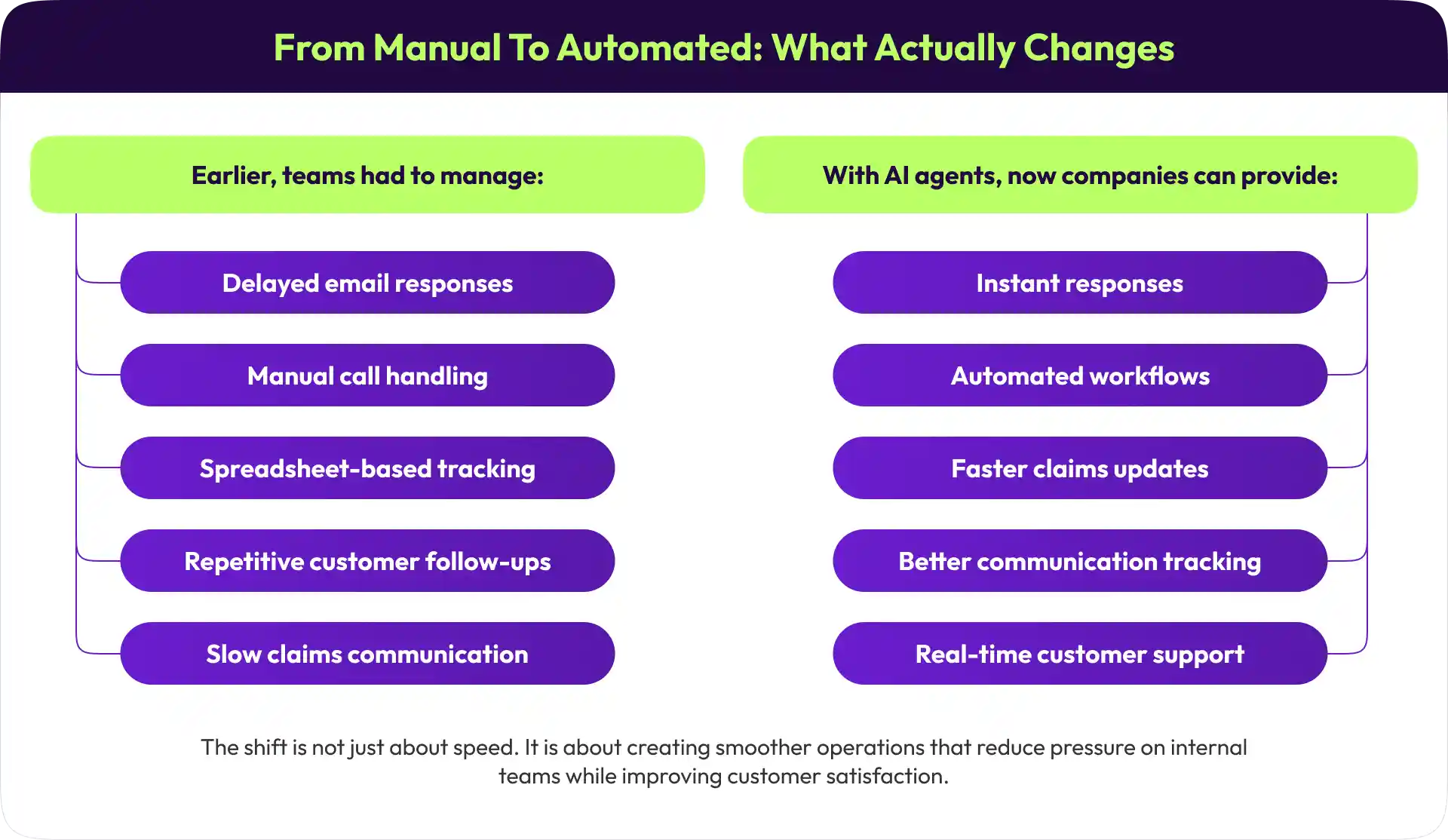
Customers now expect quick answers, instant updates, and smooth communication across every channel. But in many insurance operations, teams are still spending hours replying to repetitive emails, transferring calls, tracking claims manually, and managing fragmented workflows. Even highly skilled support teams struggle during peak volumes.
This is exactly where AI Agents for Insurance are changing the way operations work.
Instead of replacing insurance professionals, AI agents help teams handle repetitive communication and operational tasks faster and more accurately. They support customer service teams, claims departments, and operations managers by automating calls, emails, updates, and workflows while still keeping humans involved where needed.
From handling customer inquiries at any hour to simplifying claims communication, AI agents are helping insurance companies improve response times without constantly expanding support teams.
What Are AI Agents for Insurance and How Do They Work?
AI agents are intelligent systems designed to understand conversations, process requests, and complete tasks automatically. Unlike traditional chatbots or rule-based automation tools, modern AI agents can understand intent, analyze context, and take action in real time.
In insurance operations, these agents can work across multiple communication channels, including:
- Voice calls
- Emails
- Customer chat support
- Internal workflows
- Claims communication systems
For example, if a customer calls to check claim status, an AI agent can identify the customer, pull policy information, review claim progress, and provide an instant update without human involvement.
Similarly, if a customer sends an email requesting policy renewal details, the AI system can understand the request, draft the correct response, attach relevant information, and route the case if escalation is required. These systems are built specifically to support insurance workflows, customer interactions, and claims-related communication.
Where Time Is Lost in Insurance Operations
Insurance companies often lose valuable operational time in places that seem small individually but become massive when combined. Some of the most common operational bottlenecks include:
Repetitive Customer Queries
Customers regularly ask similar questions:
- What is my claim status?
- When will my policy renew?
- What documents are required?
- Is this covered under my plan?
Support teams end up answering the same questions repeatedly across calls, emails, and chat systems.
Manual Email Handling
Insurance teams spend significant time:
- Reading emails manually
- Categorizing requests
- Forwarding messages internally
- Drafting repetitive responses
This slows down response times and creates delays during high-volume periods.
Call Overflow and Long Wait Times
Peak claim periods, renewal seasons, or emergency situations can flood call centers. Customers often wait too long before reaching an agent, which affects the overall experience.
Fragmented Claims Communication
Claims processing usually involves multiple teams, documents, approvals, and customer follow-ups. Without automation, communication gaps slow everything down. Over time, these inefficiencies increase operational costs and reduce customer satisfaction.
How AI Agents Work in Insurance Operations (Step-by-Step Flow)
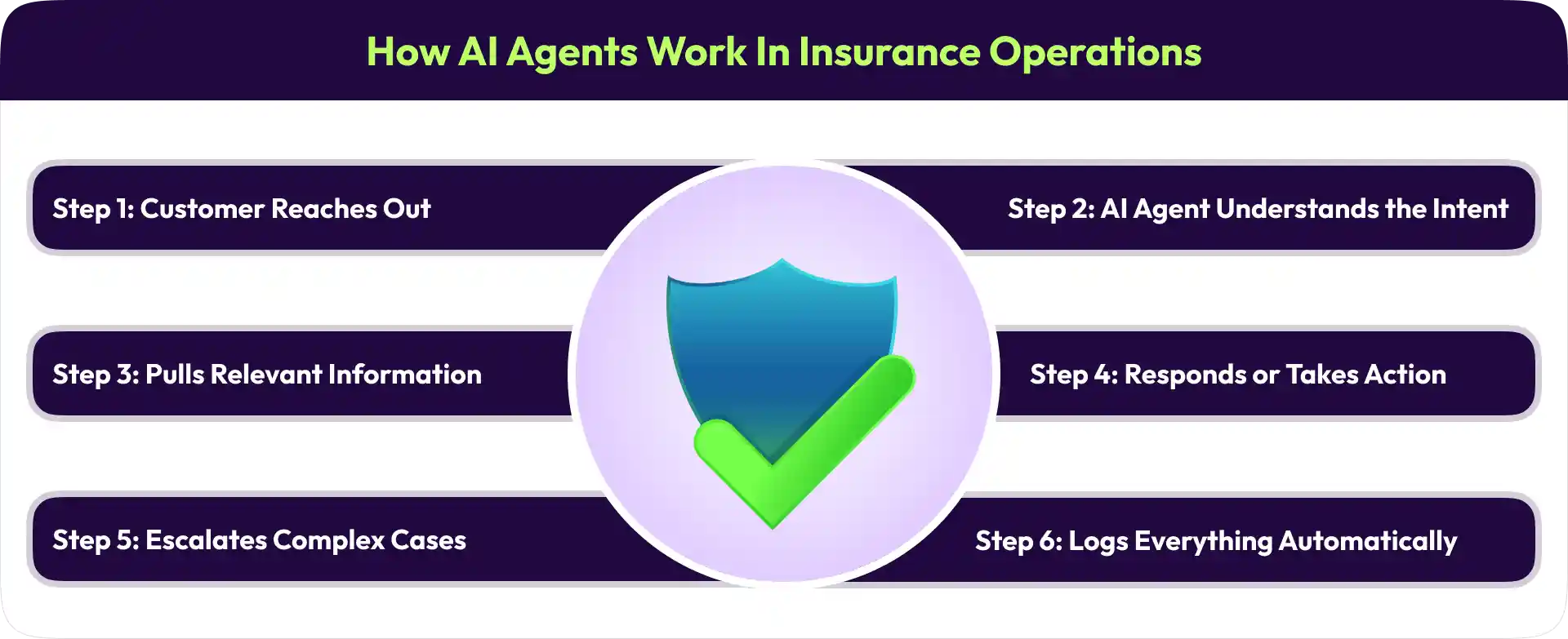
AI-powered insurance operations typically follow a structured process that simplifies communication and reduces manual effort.
Step 1: Customer Reaches Out
The customer contacts the insurance provider through:
- Phone call
- Email
- Chat support
- Online request form
Step 2: AI Agent Understands the Intent
The AI system identifies the reason behind the interaction.
For example:
- Claim inquiry
- Policy renewal
- Coverage question
- Document submission
- Payment issue
The AI agent securely accesses relevant data such as:
- Policy information
- Customer history
- Claim details
- Uploaded documents
- Previous interactions
Step 4: Responds or Takes Action
Based on the request, the system can:
- Answer questions instantly
- Send claim updates
- Schedule callbacks
- Generate responses
- Trigger workflows
- Request missing documents
Step 5: Escalates Complex Cases
If the issue requires human involvement, the AI agent routes the case to the right team with all necessary context attached.
Step 6: Logs Everything Automatically
Every interaction, update, and workflow action is automatically recorded, improving visibility and operational tracking.
Core Use Cases of AI Agents in Insurance Operations
1. AI Voice Agents for Insurance Call Handling
One of the biggest operational challenges in insurance is managing high call volumes. Customers often contact support teams for simple requests that consume valuable agent time.
This is where AI voice agents for insurance are making a major impact. These systems can:
- Handle calls 24/7
- Reduce customer wait times
- Answer policy-related questions instantly
- Provide claim status updates
- Route complex cases intelligently
- Schedule follow-ups automatically
Instead of customers waiting in long queues, AI voice systems provide immediate responses and improve overall communication efficiency. For insurance companies, this also reduces pressure on customer support teams during peak demand periods.
2. Automating Customer Emails in Insurance Operations
Email remains one of the most heavily used communication channels in insurance operations. But manual email handling often creates delays and inconsistency. With insurance email automation, AI agents can:
- Read incoming emails
- Identify customer intent
- Categorize requests automatically
- Draft accurate responses
- Forward cases to the right department
- Send follow-up updates instantly
This helps companies maintain faster response times while improving communication consistency across departments. Customers also receive quicker answers without constantly following up.
3. AI-Powered Claims Processing and Updates
Claims communication is often one of the most time-sensitive parts of insurance operations. Using AI for claims processing in insurance companies can simplify many repetitive tasks involved in claim management.
AI agents can help:
- Initiate claim requests
- Collect required information step-by-step
- Verify missing details
- Send real-time status updates
- Reduce repetitive customer follow-ups
- Keep communication centralized
Instead of customers repeatedly contacting support teams for updates, the system proactively shares information throughout the claims process. This improves transparency and reduces frustration.
4. Policy Queries and Self-Service Support
Insurance customers frequently need help with:
- Coverage details
- Renewal timelines
- Policy modifications
- Premium-related questions
- Address or contact updates
AI agents can handle these requests instantly through self-service support systems. This reduces repetitive support tickets and gives customers quicker access to information without waiting for an agent.
Reducing Operational Load Without Expanding Teams
Many insurance companies are under pressure to improve service quality while controlling operational costs. Hiring larger support teams is not always sustainable, especially when repetitive tasks continue increasing.
AI agents help reduce operational workload by automating repetitive communication and workflow activities. This allows teams to focus on:
- Complex claims
- Sensitive customer interactions
- Exception handling
- High-priority cases
During periods of high demand, AI systems also help organizations scale support operations without overwhelming internal teams. The result is better productivity without dramatically increasing staffing requirements.
Key Benefits of AI Agents for Insurance Industry
The adoption of AI Agents for Insurance is growing because the operational advantages are becoming difficult to ignore. Some of the biggest benefits include:
Faster Customer Response Times
AI agents provide immediate responses across calls, emails, and support channels.
Better Customer Experience
Customers receive faster updates, shorter wait times, and more consistent communication.
Lower Operational Costs
Automation reduces repetitive manual work and improves operational efficiency.
Consistent Communication
AI systems deliver standardized and accurate responses across channels.
Scalable Operations
Insurance companies can handle larger communication volumes without expanding teams rapidly.
Improved Operational Visibility
Every interaction and workflow step is tracked automatically, making operations easier to monitor.
Reduced Human Errors
Automation minimizes manual mistakes in repetitive tasks and communication handling.
Faster Internal Coordination
AI-powered workflows help different departments stay aligned during claims and customer support processes.
Choosing the Right AI Agent Solution for Insurance
Not every automation platform is designed specifically for insurance workflows. When evaluating AI agent solutions for insurance, companies should focus on systems that can support both customer communication and operational processes.
Key things to look for include:
Integration with Existing Systems
The platform should connect easily with:
- Policy management software
- Claims systems
- CRM platforms
- Communication tools
Multi-Channel Support
The ideal solution should handle:
- Voice calls
- Emails
- SMS
- Customer workflows
- Chat support
from a centralized system.
Workflow Customization
Insurance operations vary across companies. AI systems should adapt to existing operational processes rather than forcing rigid workflows.
Security and Compliance
Insurance data is highly sensitive. Strong security standards and compliance support are essential.
Reporting and Insights
The platform should provide operational visibility, communication analytics, and performance tracking.
Why Insurance Operations Are Moving Toward AI Automation
The insurance industry is rapidly moving toward automation because operational demands continue increasing.
Several factors are driving this shift:
- Rising customer expectations
- Growing communication volumes
- Pressure to reduce response times
- Increasing operational costs
- Demand for better customer experiences
- Need for scalable support systems
Across the broader AI in insurance industry landscape, companies are now focusing on technologies that improve efficiency without reducing service quality. AI agents are becoming an important part of that transformation.
How Alris Supports Insurance Teams with AI Agents
Alris AI helps insurance companies streamline customer communication and operational workflows using intelligent AI-powered systems. The platform supports insurance teams through:
- AI voice agents for customer call handling
- Email automation for faster response management
- Workflow automation for claims operations
- Real-time communication support
- Insurance-specific automation use cases
Alris is designed to integrate quickly with operational workflows while helping teams improve efficiency without adding unnecessary complexity. Instead of replacing support teams, the platform helps organizations reduce repetitive work and improve customer communication at scale.
Final Thought
Insurance operations are becoming more complex every year. Customers expect faster responses, real-time updates, and smoother communication across every interaction. Manual processes alone can no longer keep up with growing operational demands.
This is why AI Agents for Insurance are becoming a practical solution for modern insurance teams. From handling calls and automating emails to simplifying claims communication, AI agents help organizations improve operational efficiency without increasing workload on internal teams.
The goal is not to replace people. It is to support teams with smarter systems that reduce repetitive work, improve response times, and create better customer experiences. As insurance operations continue evolving, companies adopting AI-driven automation early will be better positioned to scale efficiently while maintaining strong customer service.