Leads are coming in. Notifications ping. Forms fill up. Slack lights up with “New inquiry received.” Feels good, right? But then you check actual closed deals at the end of the month… and something feels off. The numbers don’t match the activity. It’s like watching rain pour into a bucket that somehow never fills.
That gap? That’s where revenue quietly disappears. In most businesses, the problem isn’t demand. It isn’t traffic. It isn’t even a competition. You’re losing them because of broken follow-ups.
That’s where AI automation in sales changes the game. Not in a flashy way. Not in a “replace your team” way. But in a quiet, structured, consistent way that stops leads from slipping through the cracks. Let’s break this down properly.
Why Businesses Lose Sales Even When Leads Are Coming In
More leads should mean more revenue, right? In theory, yes. In reality… not really.
The gap between lead generation and lead conversion
Marketing brings people in. Sales is supposed to move them forward. But there’s often a messy gap in the middle.
A lead submits a form at 3:12 PM, sales sees it at 6:40 PM, and a follow-up goes out the next morning. By then? The prospect has already booked a call with someone else. Speed matters more than most teams admit.
Delayed responses and inconsistent follow-ups
Manual follow-ups depend on mood, workload, and memory. Some reps are sharp, others forget. Some days are smooth, other days are chaos. It’s human. But it’s also expensive.
Manual processes create bottlenecks
Spreadsheets. Sticky notes. Email reminders. Calendar nudges. It works… until volume increases. Then everything breaks. Leads get buried. Conversations stall. And nobody really knows where things stopped.
Lack of visibility into where leads drop off
If you ask, “Where are we losing people?” and no one can answer clearly, that’s a systems problem. Without structured tracking, you can’t fix leakage.
Why more leads don’t always mean more revenue
Increasing ad spend feels productive. Fixing follow-up systems feels boring. But here’s the uncomfortable truth: improving response time often increases revenue faster than doubling traffic.
What Is AI Automation in Sales?

Let’s keep this simple. AI automation in sales is a structured system that captures leads, responds instantly, prioritizes them intelligently, and keeps follow-ups moving without depending on someone remembering to click “send.” It’s not just scheduled emails. It’s not just CRM reminders. It’s intelligence layered on top of automation.
Basic automation vs AI-powered automation
Basic automation: “If someone fills this form, send Email A.”
AI-powered automation: “If someone fills this form, analyze their behavior, assign a score, trigger the right sequence, notify the rep, and adjust follow-up timing based on engagement.”
Where it fits in the sales cycle
AI automation sits between:
- Lead capture
- Qualification
- Engagement
- Follow-up
- Conversion
It keeps the engine running while humans focus on conversations and closing.
Lead Generation vs Lead Conversion: Where Revenue Is Really Won
Most businesses focus heavily on generating leads. They track traffic, cost per click, form submissions, and campaign performance. Those numbers feel tangible. They show movement. But revenue is not created at the moment a lead fills out a form; it’s created when that lead is converted into a paying customer.
The real problem is not usually the lead volume. It’s the gap between lead capture and lead follow-up. When response times are delayed or inconsistent, interest fades quickly. Prospects move on. In competitive industries, the first company to respond often wins the conversation.
AI automation in sales helps protect the investment already made in marketing. It ensures that every lead receives immediate acknowledgment, structured follow-up, and prioritization based on intent. Instead of increasing ad spend to generate more leads, businesses can often increase revenue faster by improving follow-up systems.
If a company generates 500 leads per month but fails to contact even 10-15% of them promptly, the revenue impact can be significant. Improving follow-up consistency often delivers a stronger return than increasing traffic. Conversion is not about pressure; it’s about discipline and timing. And discipline does not scale well manually.
Manual Sales Handling vs AI-Powered Automation
Let’s compare clearly.
Speed and Response Time
- Manual: depends on availability
- AI automation: responds instantly. Every time, minutes matter, sometimes seconds.
Time and Operational Efficiency
Manual tracking eats hours daily. Automation handles reminders, sequencing, and logging automatically. Your team stops chasing tasks and starts having real conversations.
Effort and Sales Focus
Manual systems require constant checking. AI systems quietly prioritize who needs attention today. No guesswork.
Consistency and Process Discipline
Manual processes create gaps. People skip steps. It happens. Automation ensures every lead goes through a defined path. Structured. Predictable.
Scalability
Manual systems struggle when lead volume jumps. AI automation scales without losing quality.
Manual systems give fragmented insight. AI automation provides dashboards showing:
- Response time
- Engagement rate
- Stage conversion
- Drop-off points
Now decisions are based on data, not gut feeling.
Core Components of an AI Automation in Sales System
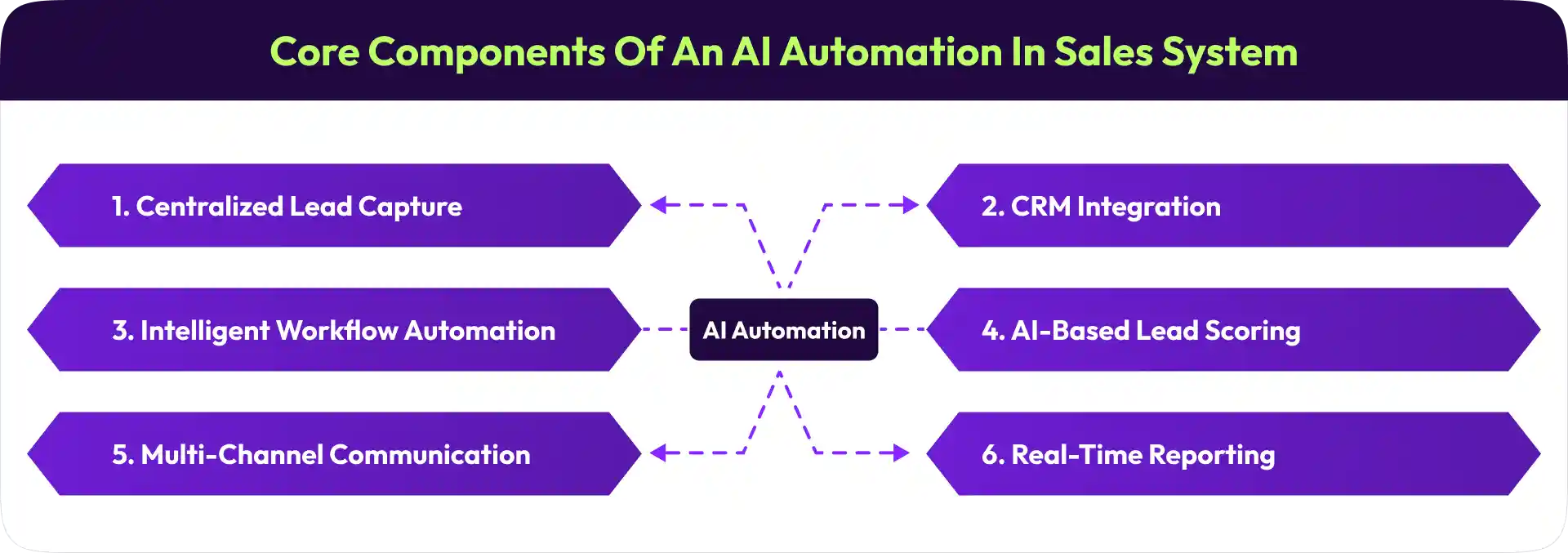
A strong AI automation system is not just a tool. It’s a structured framework designed to eliminate gaps in the sales process. When implemented correctly, it creates visibility, speed, and consistency. Here are the essential components:
1. Centralized Lead Capture
All incoming leads from websites, landing pages, ads, events, and chat tools should feed into one unified system. This eliminates scattered data, manual imports, and missed inquiries.
2. CRM Integration
The CRM acts as the operational backbone. Leads move through clearly defined stages such as Inquiry, Qualified, Proposal, and Closed. When stages are well defined, automation can trigger the correct actions at the right time.
3. Intelligent Workflow Automation
Structured workflows automatically:
- Send instant confirmations
- Assign leads to sales representatives
- Trigger reminders
- Schedule follow-ups
- Escalate high-priority opportunities
This reduces manual oversight and prevents delays.
4. AI-Based Lead Scoring
Not every lead has the same level of intent. AI analyzes behavior such as page visits, email engagement, and repeated interactions to prioritize high-potential prospects. This helps sales teams focus where it matters most.
5. Multi-Channel Communication
A modern system supports communication across email, SMS, messaging apps, and scheduling tools. This improves engagement without overwhelming the prospect.
6. Real-Time Reporting
Dashboards provide visibility into:
- Response time
- Conversion rates by stage
- Pipeline movement
- Drop-off points
Without measurement, optimization becomes guesswork.
How AI Automation in Follow-Ups Reduces Lead Leakage?
Lead leakage is rarely obvious. It usually happens quietly through delayed responses, inconsistent reminders, or missed re-engagement opportunities. Over time, these small gaps accumulate into lost revenue. AI automation reduces leakage in several ways.
When a prospect submits an inquiry and receives an immediate confirmation, it builds trust and sets expectations. Even a short message can prevent uncertainty.
Structured multi-step engagement
Instead of relying on a single email, the system maintains a consistent communication rhythm. For example:
- Day 0: Confirmation
- Day 2: Value-focused follow-up
- Day 5: Reminder
- Day 7-10: Escalation or check-in
This structured approach keeps conversations active without becoming intrusive.
Behavioral Triggers and Intelligence
If a prospect repeatedly visits pricing pages or opens multiple emails, the system can flag the lead for priority attention. If engagement drops, messaging can adjust accordingly.
Automatic reminders for inactive leads
Automated task reminders ensure sales representatives never forget critical follow-ups. The result is a disciplined process that runs consistently, even during busy periods.

Real-World Example - How Structured AI Follow-Ups Improve Conversion Rates
Consider a mid-sized B2B company generating around 600-800 leads per month. Their marketing performance was stable, and traffic was consistent. However, their average first response time ranged between 12 and 16 hours.
After implementing structured AI follow-up automation, several changes were introduced:
- Instant acknowledgment for every inquiry
- Automated meeting scheduling links
- Lead scoring based on engagement behavior
- Escalation rules for high-intent prospects
Within three months, their first response time dropped below five minutes. Meeting bookings increased by more than 20%, and conversion rates improved steadily. Importantly, they did not increase marketing spend during this period. The improvement came from process discipline, not additional advertising. This demonstrates how small structural changes in follow-up can significantly impact revenue.
Step-by-Step Process to Implement AI Automation in Sales
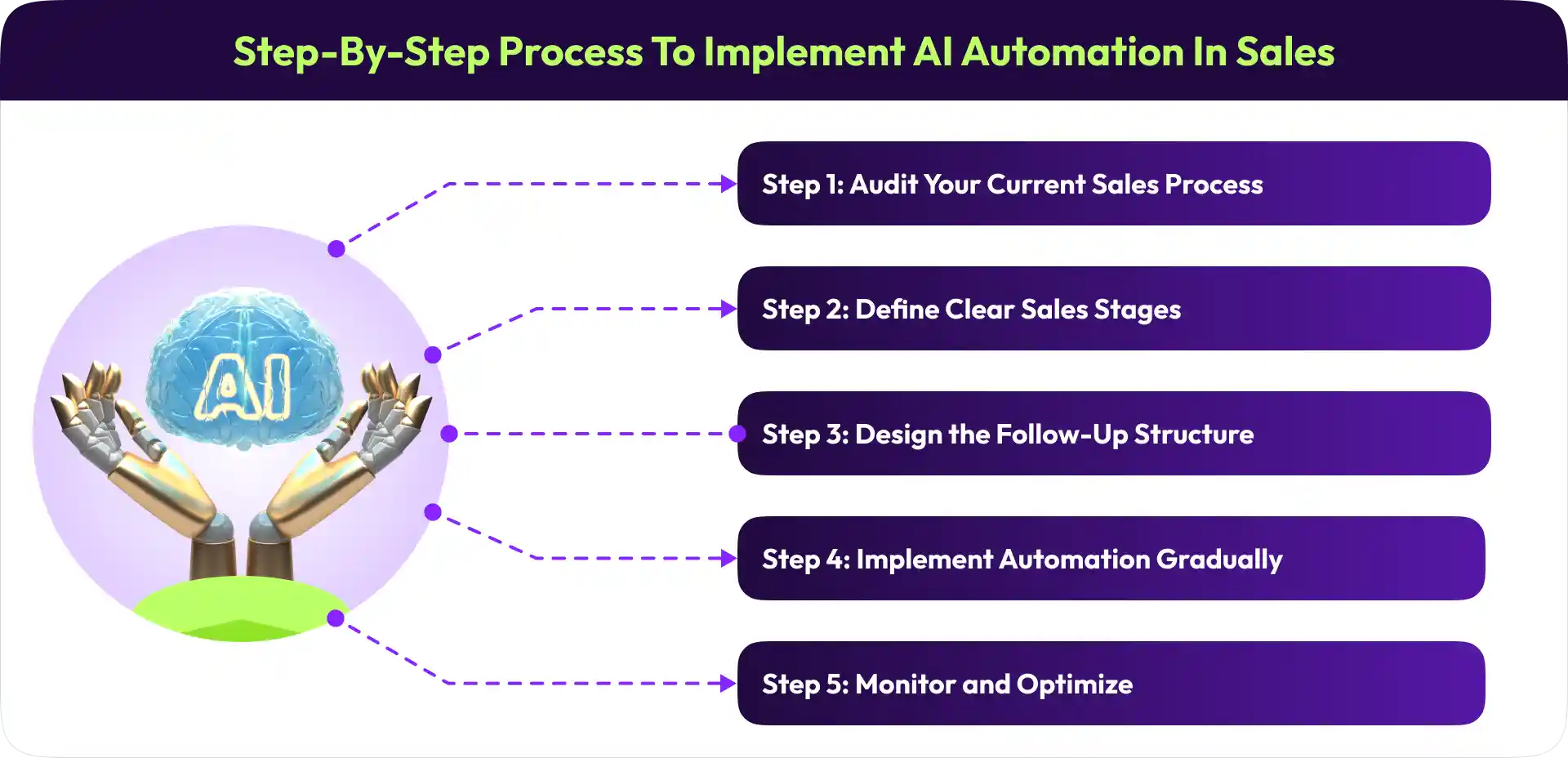
Adopting AI automation does not require a complex overhaul. It requires a clear, phased approach.
Step 1: Audit Your Current Sales Process
Analyze where delays occur. Measure response times and identify how many leads remain uncontacted after 24 hours. Understanding the current state is essential before introducing automation.
Step 2: Define Clear Sales Stages
Document each stage of the sales journey. Clearly define criteria for movement between stages. This clarity ensures automation triggers correctly.
Step 3: Design the Follow-Up Structure
Create a structured sequence for communication. Determine the timing, messaging tone, and escalation logic. Keep it helpful and relevant rather than overly aggressive.
Step 4: Implement Automation Gradually
Start with essential features such as instant acknowledgment and task reminders. Then gradually introduce lead scoring and advanced workflows.
Step 5: Monitor and Optimize
Review performance metrics regularly. Adjust messaging, timing, and scoring models based on data. Automation improves over time when refined consistently.
Where AI Adds Intelligence Beyond Basic Automation
Basic automation follows predefined rules. AI-driven automation adds adaptability and predictive insight. It can:
- Predict conversion likelihood based on past data
- Adjust follow-up timing based on engagement behavior
- Personalize communication using browsing patterns
- Identify stalled deals that require intervention
Instead of simply executing tasks, AI analyzes patterns at scale. It supports human decision-making by highlighting opportunities and risks that might otherwise go unnoticed. This combination of automation and intelligence improves efficiency without removing human involvement.
Common Mistakes Businesses Make with Sales Automation
While automation can improve sales performance, improper implementation can create new challenges. Common mistakes include:
- Implementing automation without clearly defined sales stages
- Over-automating communication, leading to robotic interactions
- Ignoring performance metrics after setup
- Failing to assign ownership of the system
- Treating automation as a one-time project rather than an evolving process
To avoid these issues, businesses should maintain a balance between automation and personalization, regularly review data, and ensure accountability within the team.
How to Measure the Success of Artificial Intelligence Automation?
Success should be measured using practical, outcome-driven metrics. Focus on indicators that directly reflect system efficiency and revenue impact. Key metrics include:
- First response time
- Lead-to-meeting conversion rate
- Opportunity-to-close rate
- Average sales cycle duration
- Percentage of uncontacted leads
- Revenue per lead
A reduction in response time combined with improved conversion rates typically signals that automation is functioning effectively. These metrics provide clarity and allow continuous improvement.
When Should a Business Adopt AI Automation in Sales?
AI automation becomes essential when sales processes begin to show strain. Businesses should consider adoption if they experience:
- Increasing lead volume
- Sales team overload
- Missed or delayed follow-ups
- Inconsistent revenue patterns
- Limited visibility into pipeline performance
Early implementation prevents small inefficiencies from turning into larger revenue leaks. Waiting until the system breaks often results in higher recovery costs.
The Long-Term Impact of AI Automation on Revenue Growth
Over time, AI automation creates predictability. Revenue forecasting becomes more accurate because follow-ups are consistent and measurable. Marketing and sales alignment improves as both teams rely on shared data rather than assumptions. Long-term benefits include:
- Reduced lead leakage
- Improved operational efficiency
- Shorter response times
- Higher conversion consistency
- More reliable revenue forecasting
Perhaps the most overlooked benefit is stability. Sales operations become less reactive and more structured. Teams spend less time managing chaos and more time focusing on meaningful conversations with qualified prospects. When systems improve, revenue growth becomes more consistent. Not necessarily dramatic overnight, but steady, measurable, and sustainable.
Final Thought
Sales shouldn’t rely on memory or luck. If follow-ups depend on who’s available or who remembers to reply, leads will slip through. It’s not a people problem. It’s a systems problem.
AI automation in sales brings structure. It ensures every lead is acknowledged, tracked, and followed up on consistently. It reduces delays, improves visibility, and allows sales teams to focus on conversations instead of reminders.
Growth doesn’t always require more leads. Often, it requires better handling of the leads you already have. When sales become a structured system rather than a scattered effort, conversions improve naturally. And revenue becomes more predictable, which, honestly, is what most businesses want in the first place.
Frequently Asked Questions (FAQs)
1. What is sales automation, and why does it matter?
Sales automation uses technology to handle repetitive tasks like follow-ups, lead assignment, and CRM updates. It matters because slow or inconsistent follow-ups are one of the biggest reasons businesses lose qualified leads.
2. How does AI improve follow-ups in the sales process?
AI ensures instant responses, tracks lead behavior, and prioritizes high-intent prospects. It removes guesswork and helps sales teams focus on the leads most likely to convert.
3. Can AI automation replace my sales team?
No. AI supports your team by handling repetitive tasks. Sales reps still manage conversations, objections, and closing. Automation simply makes them more efficient.
4. How does lead scoring work with AI automation?
AI analyzes engagement data like website visits and email clicks to rank leads based on buying intent. This helps teams prioritize serious prospects instead of chasing low-interest inquiries.
5. What are common mistakes to avoid with sales automation?
Common mistakes include over-automating, ignoring performance data, and setting up automation without clear sales stages. Automation works best when it supports a structured process.
6. How can I measure if my AI automation is working?
Track response time, lead-to-meeting rate, close rate, and percentage of uncontacted leads. If response time drops and conversions improve, the system is working.
7. How does Alris help with AI automation in sales?
Alris AI builds structured AI-powered sales systems that improve follow-ups, reduce missed leads, and create measurable, predictable sales processes tailored to business goals.