Insurance customer support teams are under constant pressure today. Call volumes are increasing, customer expectations are rising, and support teams are expected to resolve issues faster than ever before. At the same time, a large portion of these calls are repetitive for policy questions, claim updates, billing queries, and renewal reminders.
This creates a bottleneck. Agents spend most of their time answering the same questions, while customers wait longer for support. It’s inefficient on both sides.
This is where AI voice agents are changing the game.
Instead of expanding teams endlessly, insurers are now using AI to handle routine conversations automatically. The result is faster service, lower workload, and a better overall customer experience.
In this blog, you’ll understand how AI voice agents in insurance work, why support teams struggle with overload, and how voice AI in customer support helps insurers scale without chaos.
Why Insurance Customer Support Teams Face High Call Volumes
If you look at daily operations in an insurance call center, most incoming calls fall into predictable categories. Customers usually reach out for policy-related clarifications, billing issues, or updates on their claims.
Common reasons include:
- Questions about policy coverage and benefits
- Premium payments and billing concerns
- Claim status updates and document follow-ups
- Policy renewals, cancellations, or endorsements
- First Notice of Loss (FNOL) after accidents
Now, combine this with external triggers. During renewal cycles or open enrollment periods, call volumes spike significantly. After natural disasters or large-scale incidents, claim-related calls can surge overnight.
The real challenge isn’t just volume, it’s variability. Support teams often can’t scale fast enough to handle sudden spikes, which leads to long wait times and poor customer experiences.
What Are AI Voice Agents?
AI voice agents are intelligent systems that can handle customer conversations over phone calls, much like a human agent.
But unlike traditional IVR systems that rely on menu-based navigation, these agents can understand natural speech and respond accordingly. Customers don’t need to press buttons or follow rigid flows, they can simply speak.
AI voice agents for insurance can:
- Understand spoken queries in real time
- Identify customer intent
- Access backend systems like CRM, claims, and billing
- Provide relevant, personalized responses
- Complete routine tasks without human intervention
They are designed not just to route calls, but to resolve them. And when needed, they can transfer calls to human agents along with full conversation context.
How AI Voice Agents Work in Insurance Customer Support
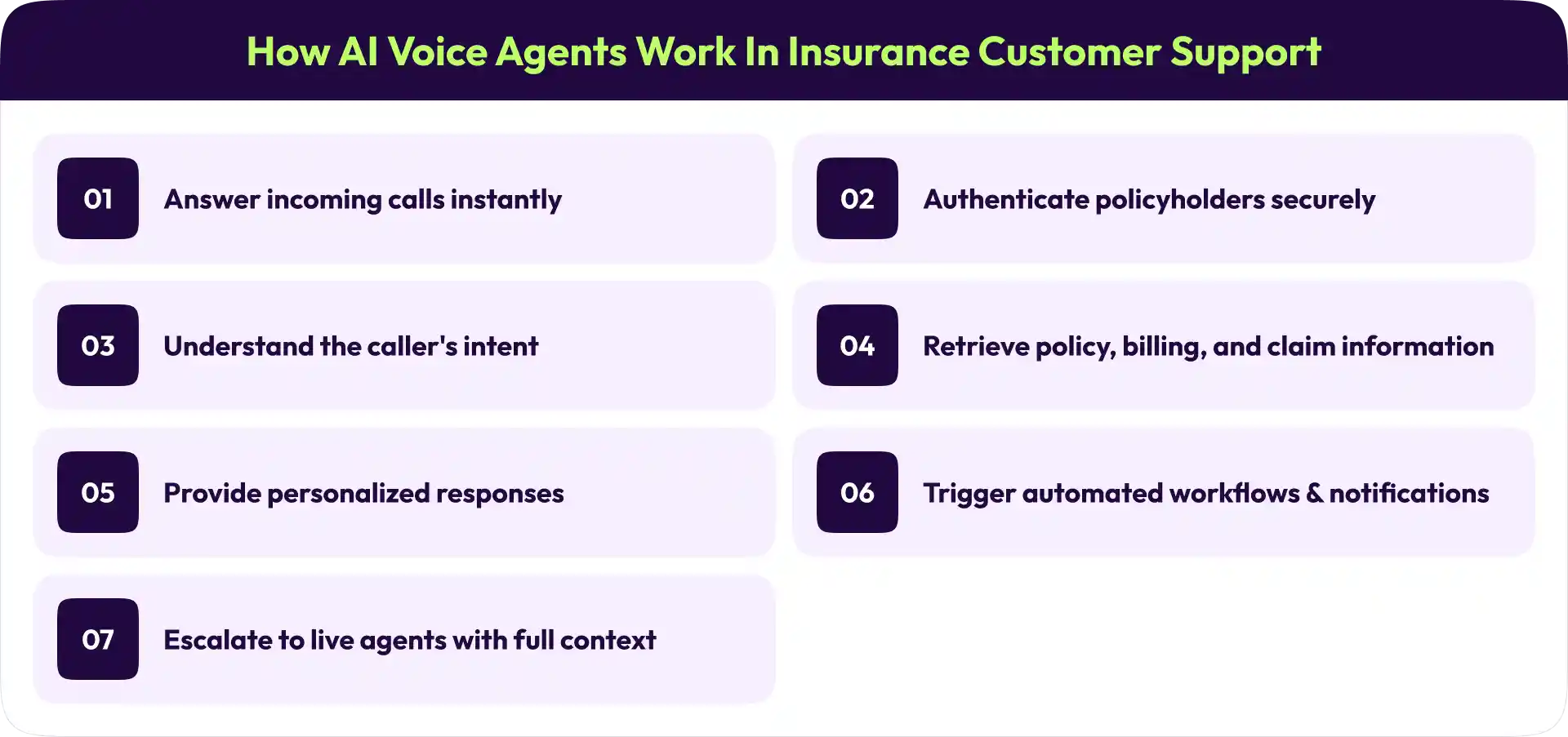
AI voice agents operate through a structured, intelligent workflow that enables them to handle customer conversations from start to resolution without delays.
- Instant call answering without queues or delays: Every incoming call is answered immediately, eliminating wait times and improving the first impression of customer support.
- Secure and seamless policyholder authentication: Uses verification methods like OTP, registered mobile validation, or policy details to ensure secure access to sensitive information.
- Accurate understanding of caller intent using NLP: Interprets natural speech to identify the exact reason for the call, whether it's claims, billing, or policy queries.
- Real-time data retrieval from backend systems: Connects with CRM, policy, and claims systems to fetch live and accurate information within seconds.
- Context-aware and personalized responses: Delivers answers tailored to the customer’s profile, history, and current request, making conversations more relevant.
- Automated workflow execution and notifications: Initiates actions like sending reminders, requesting documents, or updating records during the call itself.
- Smooth escalation to human agents with full context transfer: Transfers complex cases along with conversation history, reducing repetition and improving resolution speed.
Insurance Customer Support Processes That Can Be Automated
A significant portion of insurance customer support is repetitive and rule-based. These interactions don’t always require human judgment, which makes them ideal for automation. AI voice agents can handle:
- Policy information and coverage clarification requests: Instantly explains policy inclusions, exclusions, and benefits in a simple and understandable way.
- Billing support and proactive premium payment reminders: Notifies customers about due payments, confirms transactions, and resolves common billing concerns.
- Claim status tracking and proactive follow-up updates: Provides real-time claim progress and keeps customers informed without requiring repeated calls.
- Automated document collection and verification support: Guides customers on required documents and follows up until submission is complete.
- Renewal reminders and end-to-end policy servicing: Engages customers before deadlines, reducing last-minute pressure and missed renewals.
- Beneficiary, nominee, and contact information updates: Allows secure and quick updates without manual intervention.
- Appointment scheduling with agents, advisors, or adjusters: Handles booking and appointment scheduling efficiently without back-and-forth coordination.
- Customer feedback collection and post-interaction follow-ups: Gathers insights automatically to improve service quality and customer experience.
By automating these processes, insurers can reduce operational load without compromising service quality.
How AI Voice Agents Reduce Overload
AI voice agents directly address the core reasons behind customer support overload, high call volumes, repetitive queries, and sudden spikes in demand. Instead of just assisting teams, they help streamline the entire support process. Here’s how:
1. They Handle Repetitive Calls at Scale
A significant portion of insurance queries are repetitive, such as claim status, policy details, or billing questions. AI voice agents take over these routine interactions, allowing them to be handled quickly and consistently without involving human agents every time.
2. 24/7 Availability Without Hiring More Staff
Customer needs don’t follow business hours. AI voice agents provide round-the-clock support, ensuring customers can get help anytime without requiring additional staffing or increasing operational costs.
3. Reduced Wait Times and Call Abandonment
Since AI can manage multiple calls simultaneously, customers don’t have to wait in long queues. This leads to faster responses, fewer dropped calls, and a smoother overall experience.
4. Lower Average Handling Time
AI voice agents can instantly access and deliver information from backend systems, reducing the time spent on each call. This helps resolve queries faster without compromising accuracy.
5. Improved First-Call Resolution
With access to real-time data and the ability to perform actions during the call, AI can resolve many issues in a single interaction. This reduces the need for follow-ups and repeat calls.
6. Instant Scalability During Peak Demand
Whether it’s renewal season or a sudden surge in claims, AI voice agents can scale instantly to handle increased demand without delays or service disruptions.
7. Frees Human Agents for Complex Work
By taking over routine tasks, AI allows human agents to focus on more complex, sensitive, or high-value customer interactions where human judgment is essential.
Overall, AI voice agents help shift insurance support from being reactive and overloaded to more efficient, scalable, and customer-friendly operations.
Benefits of AI Voice Agents for Insurance Companies
The adoption of AI voice agents brings both immediate operational gains and long-term strategic advantages. Some of the key benefits include:
- Significant reduction in customer support costs: Decreases dependency on large teams for handling routine queries.
- Faster response times and improved service efficiency: Ensures customers receive answers instantly, improving satisfaction.
- Enhanced policyholder experience and engagement: Creates a smoother, more responsive support journey.
- Increased productivity and efficiency of support teams: Allows agents to focus on complex problem-solving instead of repetitive tasks.
- Consistent, accurate, and compliance-ready communication: Ensures standardized responses aligned with regulatory requirements.
- Better management of peak call volumes and demand spikes: Maintains performance even during high-pressure situations.
- Scalable and future-ready customer support operations: Supports growth without a proportional increase in operational complexity.
Real-World Use Cases of Voice AI in Customer Support
AI voice agents are actively used across multiple insurance segments, supporting both routine operations and critical scenarios.
Auto Insurance Customer Support Automation
- First Notice of Loss (FNOL) reporting after accidents
- Claim status updates and repair tracking
- Roadside assistance coordination
- Policy renewal and coverage modification queries
Health Insurance Customer Interaction Automation
- Coverage and benefits verification
- Prior authorization and approval status updates
- Claims and reimbursement tracking
- Network provider and eligibility assistance
Property and Casualty Insurance Support
- Property damage claim intake and reporting
- Catastrophe response after floods, fires, or storms
- Document collection and verification follow-ups
- Policy endorsements and coverage updates
Life Insurance Customer Service Automation
- Policy information and premium reminders
- Beneficiary and nominee updates
- Application and underwriting status tracking
- Policy servicing and renewal support
Billing and Payment Support Automation
- Premium due reminders and alerts
- Payment confirmations and receipts
- Outstanding balance notifications
- Auto-debit setup and billing assistance
Renewals and Customer Retention Workflows
- Policy renewal reminders and alerts
- Coverage review and upgrade assistance
- Cancellation prevention and retention outreach
Claims Operations and Backend Coordination
- Missing document follow-ups
- Adjuster appointment scheduling
- Settlement status updates and communication
Catastrophe and High-Volume Event Response
- Handling sudden spikes in claims-related calls
- Providing mass updates to affected customers
- Collecting loss details at scale
- Reducing operational pressure during crisis situations
Multilingual Customer Support Across Regions
- Serving customers in multiple languages
- Ensuring consistent communication globally
- Improving accessibility and inclusivity in service delivery
Key Features to Look for in an Insurance AI Voice Agent
Choosing the right solution matters, especially in insurance, where accuracy, security, and compliance are critical. Not all AI voice agents are built to handle industry-specific requirements, so it’s important to evaluate the right capabilities before making a decision.
Look for features like:
Integration with claims, policy, CRM, and billing systems
The AI voice agent should connect seamlessly with your existing systems to access real-time data. Without proper integration, responses may be delayed or inaccurate, reducing the effectiveness of automation.
Secure identity verification mechanisms
Since insurance interactions involve sensitive customer data, the system must support secure authentication methods such as OTP, policy validation, or other verification layers to ensure safe access.
Compliance-ready call logs and audit trails
Every interaction should be recorded and traceable. This helps meet regulatory requirements and ensures transparency, which is essential in the insurance industry.
Multilingual support capabilities
The ability to communicate in multiple languages allows insurers to serve a wider customer base while maintaining consistent service quality across regions.
Custom workflows tailored for insurance operations
Insurance processes vary across claims, renewals, and policy servicing. The AI solution should be flexible enough to adapt to these workflows rather than forcing standard templates.
Smooth escalation to human agents
Not all queries can be automated. The system should transfer complex cases to human agents seamlessly, along with full conversation context to avoid repetition.
How Alris AI Helps Insurance Companies Automate Customer Support
Alris AI is designed to help insurance companies move beyond manual, overloaded support operations and adopt a more scalable, efficient approach to customer interactions. It focuses on automating high-impact workflows while maintaining accuracy, security, and customer experience.
- Purpose-built AI voice agents for insurance workflows: Unlike generic solutions, Alris AI is tailored for insurance-specific processes like claims, policy servicing, and renewals, so you get faster deployment and better results from day one.\
- Automates claim intake, policy servicing, and renewals: From FNOL to renewal reminders, Alris AI handles high-volume interactions end-to-end, helping you reduce delays, improve turnaround times, and enhance customer satisfaction.
- Connects with existing insurance systems: Seamlessly integrates with your CRM, claims, billing, and policy platforms, so there’s no need to replace your current setup while still unlocking real-time automation.
- Supports secure and compliant conversations: Built with structured workflows, authentication layers, and audit-ready logs, ensuring every interaction meets industry compliance standards without added effort.
- Provides 24/7 customer support: Deliver instant, always-on support to your customers without increasing team size, improving accessibility while keeping operational costs under control.
- Reduces operational workload while improving service quality: By automating repetitive queries, Alris AI frees your team to focus on complex, high-value interactions leading to better productivity and a more consistent customer experience.
Conclusion
Insurance customer support teams are dealing with increasing pressure from high call volumes and repetitive queries. Traditional approaches are no longer enough to handle this scale efficiently.
AI voice agents offer a practical and scalable solution. By automating routine conversations across claims, billing, and policy servicing, they reduce workload, improve response times, and enhance customer satisfaction. At the same time, they allow human agents to focus on what truly matters: complex and sensitive customer needs.
For insurers looking to modernize their operations, AI voice agents are no longer optional. They are becoming a core part of efficient, future-ready customer support.
Frequently Asked Questions (FAQs)
1. What insurance customer support tasks can AI voice agents automate?
They can handle claim intake, policy information requests, premium payment reminders, renewal notifications, document follow-ups, and appointment scheduling with agents or adjusters.
2. Can AI voice agents assist with insurance claims?
Yes. AI voice agents can collect First Notice of Loss (FNOL) details, provide claim status updates, request missing documents, and guide customers through the next steps in the claims process.
3. Are AI voice agents better than traditional IVR systems?
Yes. AI voice agents understand natural conversations and provide personalized responses, while traditional IVR systems rely on fixed menus and limited options.
4. Can AI voice agents provide 24/7 insurance customer support?
Absolutely. They can answer calls any time of day, including nights, weekends, and holidays, so policyholders receive immediate assistance whenever they need help.
5. Which types of insurance companies can use AI voice agents?
Auto, health, life, and property and casualty insurers can use AI voice agents to automate customer support, claims communication, billing, and renewals.
6. How do AI voice agents improve the policyholder experience?
They reduce wait times, provide faster answers, and deliver consistent support across every interaction, helping customers get the information they need more quickly.