Summary: An automated ordering system for restaurants uses software or AI to handle customer orders with less manual staff involvement. In 2026, AI-powered systems can go beyond fixed menus by answering phone calls, understanding natural language, taking orders, handling modifications, and connecting conversations with restaurant workflows.
Restaurants have been automating parts of the ordering process for years. Online ordering, self-service kiosks, QR-code menus, and digital payments are now common.
But there is still one channel that can create a surprising amount of work: the phone.
Customers call with questions, ask for substitutions, change quantities, check availability, or simply prefer speaking with someone before placing an order. During a busy lunch or dinner rush, answering those calls can pull employees away from the customers standing right in front of them.
That is where an automated ordering system for restaurants is becoming more useful in 2026.
Modern AI-powered systems can handle phone conversations, understand what customers are asking, take orders, manage modifications, and pass information into the restaurant's workflow. The goal isn't to replace the entire ordering experience. It's to remove repetitive work that keeps staff tied to the phone.
What Is an Automated Ordering System for Restaurants?
An automated restaurant ordering system uses software to help customers place orders without requiring an employee to handle every step manually.
Traditional systems usually focus on structured ordering. A customer opens an online menu, selects items, chooses options, and checks out. Kiosks work in a similar way.
AI takes a different approach. With AI phone ordering for restaurants, a customer can call and have a natural conversation with an AI system. Instead of pressing numbers through a phone tree or repeating a rigid command, they can ask questions and explain what they want.
For example, a customer might say: "I'd like two chicken sandwiches, but can you make one without onions and add fries to both?"
A conversational AI system can understand the request and work through the details.
How AI Changes Automated Restaurant Ordering
The biggest difference is flexibility. Rule-based automation generally expects a customer to follow a predefined path. Conversational AI can interpret intent and respond based on what the customer actually says.
That matters in restaurants because orders aren't always clean and predictable. Customers ask questions. They change their minds. They forget something. They want to know whether a particular item can be modified.
AI can handle these conversations while following the restaurant's defined menu, policies, and ordering workflow.
Why Traditional Restaurant Ordering Systems Still Have Gaps
Automated ordering has already solved many problems, but traditional systems still have limitations.
They Depend on Fixed Menus and Workflows
Online ordering platforms are excellent when customers know what they want. But what happens when someone asks, "Can I get the burger without cheese, but replace the fries with a side salad?"
A fixed interface may support the request. Or it may not. Customers can end up clicking through several options, abandoning the order, or calling the restaurant anyway.
Phone Orders Still Depend on Staff
This is one of the biggest gaps. The phone rings. Someone has to answer it. During a quiet afternoon, that's usually fine. During a Friday dinner rush, it's a different story.
An employee may already be taking an order, helping a guest, packing food, or dealing with a delivery driver. If nobody can answer the phone, the customer may hang up and call somewhere else.
Staff Have to Switch Between Tasks
Restaurant employees already juggle plenty of responsibilities. They may be serving guests while answering calls, checking order details, responding to menu questions, and handling pickup requests.
Constant task switching creates friction. It also makes simple mistakes more likely. A restaurant automation system can take some of that repetitive communication off the team's plate.
6 Ways AI Improves Restaurant Ordering in 2026
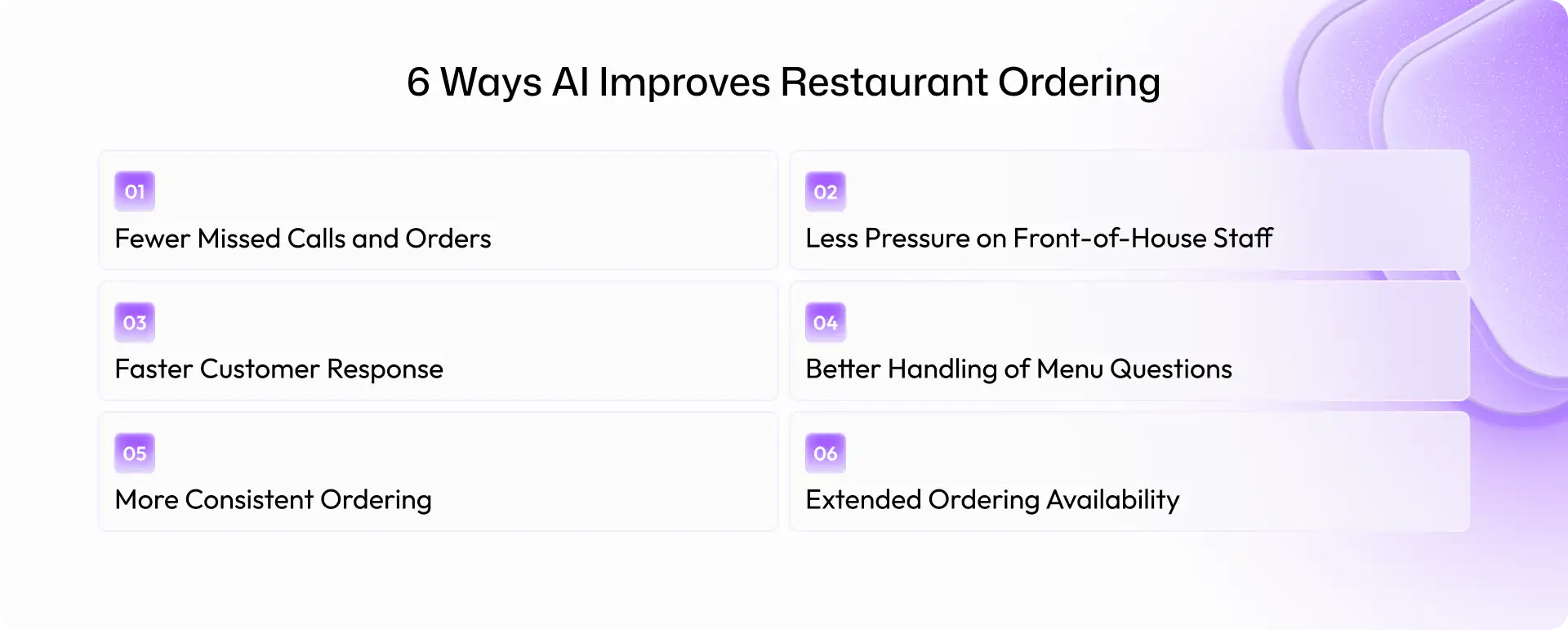
1. Fewer Missed Calls and Orders
A busy restaurant can't always answer every call. AI phone automation gives restaurants a way to respond to calls even when employees are occupied.
For restaurants that receive a steady stream of phone orders, this can make a meaningful operational difference.
2. Less Pressure on Front-of-House Staff
Employees shouldn't have to choose between helping a guest at the counter and answering a ringing phone.
When AI handles routine calls, staff can stay focused on the people physically in the restaurant. That's a small operational change, but it can make busy shifts feel less chaotic.
3. Faster Customer Response
Nobody enjoys sitting on hold just to ask whether an item is available.
An automated system can respond immediately to common questions and begin the ordering process without waiting for an employee. For customers, that means less friction.
4. Better Handling of Menu Questions
Restaurant calls aren't always about placing an order. Customers may ask about ingredients, menu options, substitutions, availability, or other details.
A properly configured AI system can answer these questions based on the restaurant's information instead of making employees repeat the same answers dozens of times a day.
5. More Consistent Ordering
Human employees can make mistakes, especially when they're rushed. AI follows the same defined ordering process each time.
That doesn't mean AI is perfect. It still needs accurate menu information, clear workflows, and sensible rules. But when configured properly, it can reduce some of the inconsistencies that happen during hectic shifts.
6. Extended Ordering Availability
Restaurants don't always have the same staffing levels throughout the day. An AI system can handle calls outside peak staffing periods, depending on how the restaurant configures it.
That can be useful for restaurants that want customers to place orders or get basic information without requiring an employee to stay available for every call.
How an AI-Powered Automated Ordering System Works
The exact setup depends on the restaurant, but the basic process is fairly straightforward.
1. The AI Answers the Call
Instead of sending every call to an employee, the AI can answer incoming calls automatically. This is especially useful during busy periods when employees can't step away from what they're doing.
The customer gets an immediate response instead of waiting for someone to become available.
2. It Understands What the Customer Wants
The customer doesn't necessarily have to use specific commands. They can ask about the menu, mention several items together, or explain a request in their own words.
The AI interprets the conversation and determines what information is needed to complete the order.
3. It Takes and Modifies the Order
This is where conversational ordering becomes more useful than a basic automated phone menu. Depending on the restaurant's setup, the AI can work through:
- Menu items
- Quantities
- Sizes
- Add-ons
- Substitutions
- Special requests
- Pickup or delivery details
If the customer changes an item halfway through the conversation, the system can adjust the order instead of forcing the customer to start again.
4. It Confirms the Order
Before completing the interaction, the AI can repeat important order details. That gives the customer an opportunity to catch something that doesn't look right.
It also creates a more consistent ordering process, particularly when employees would otherwise be rushing through calls during peak hours.
5. The Order Moves Into the Restaurant Workflow
The useful part isn't just the conversation. The information collected during the call needs to reach the restaurant's existing workflow. Depending on the technology stack, this can involve integrations with POS or other restaurant systems.
That connection is important. An AI that answers the phone but leaves employees manually copying every order into another system hasn't solved the whole problem.
Where an Automated Restaurant Ordering System Makes the Most Sense
Not every restaurant needs the same level of automation.
Quick-Service Restaurants
QSRs often deal with high order volumes and repetitive customer interactions. Automating common phone orders can help reduce pressure when several things are happening at once.
Takeout and Delivery Restaurants
Restaurants that depend heavily on takeout and delivery can benefit from making phone ordering easier to manage.
Instead of tying up an employee with every incoming order, an AI voice agent can handle routine conversations and collect the necessary information.
Multi-Location Restaurant Groups
Consistency becomes harder when a restaurant operates multiple locations.
An AI system can provide a standardized ordering experience while still using location-specific menus, hours, and rules where the technology supports it.
Busy Independent Restaurants
Smaller restaurants often have fewer employees available to answer calls. For these businesses, one person spending several minutes on the phone can have a bigger operational impact.
Restaurants With High Call Volume
This is probably the clearest use case. If the phone rings constantly, employees regularly miss calls, or staff complain about interruptions during service, restaurant phone automation is worth evaluating.
The Future of Restaurant Ordering Is More Conversational
Restaurant automation is moving beyond simple task automation. The earlier generation of automation focused on helping customers complete predefined steps.
AI is making it possible to build systems that understand intent and take the next action. The shift looks something like this:
Manual → Automated → Conversational → Action-oriented
That's important because restaurant operations involve a lot of small decisions.
- A customer asks a question. The system needs to understand it.
- The customer changes an order. The system needs to update it.
- The customer wants to know whether an item is available. The system needs to provide the right information.
The value isn't simply that AI can "talk." It's that it can connect the conversation to an actual restaurant workflow.
What Should You Look for in an AI Restaurant Ordering System?
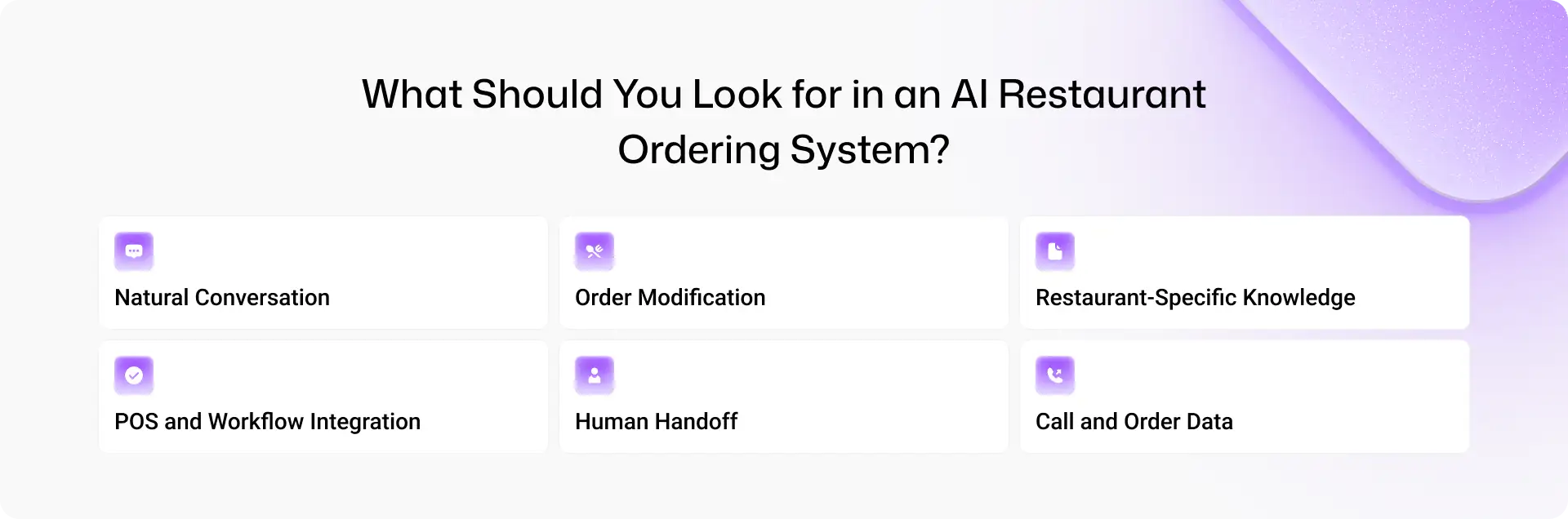
Not every AI ordering solution will work the same way. Before choosing one, look beyond the demo.
Natural Conversation
Can customers speak normally? They shouldn't have to memorize commands or speak like they're talking to a machine.
Order Modification
The system should be able to handle the kinds of changes customers actually make: substitutions, add-ons, quantities, and special requests.
Restaurant-Specific Knowledge
The AI needs accurate information about the restaurant's menu, operating hours, policies, and ordering rules.
An AI that gives the wrong answer about a menu item is worse than having a staff member answer the phone.
POS and Workflow Integration
Ask how orders move from the AI conversation into the restaurant's existing systems. Integration can be one of the most important parts of an automated ordering system.
Human Handoff
There will always be situations that need a person. A good system should have a clear way to transfer complicated or sensitive interactions to staff instead of trapping the customer in an automated loop.
Call and Order Data
Restaurant operators should also be able to understand what's happening.
How many calls came in? How many were handled? What are customers asking about? Where are calls being transferred?
These insights can help identify operational problems that aren't obvious from the kitchen or dining room.
Final Takeaway: Should Your Restaurant Use an Automated Ordering System?
An automated ordering system for restaurants isn't automatically the right answer for every business. But if your restaurant regularly deals with missed calls, repetitive phone questions, staff interruptions, or high takeout and delivery volume, it's worth looking at what AI can handle.
Ask yourself:
- Do we regularly miss phone calls during busy periods?
- Are employees constantly interrupted by the phone?
- Do customers ask the same menu questions repeatedly?
- Does staff have to switch between serving guests and taking orders?
- Do we operate multiple locations?
- Are we looking for ways to handle more orders without adding the same amount of manual work?
If several answers are yes, an AI-powered ordering system could make sense.
The goal isn't to remove people from restaurant operations. It's to let people spend more time on work where human attention actually matters. And honestly, that's probably the better way to think about restaurant AI in 2026.

Frequently Asked Questions (FAQs)
1. What is an automated ordering system for restaurants?
An automated ordering system uses software to help customers place orders with less manual staff involvement. Modern AI systems can also handle natural conversations, answer questions, modify orders, and support phone-based ordering.
2. Can AI take restaurant orders over the phone?
Yes. AI-powered phone systems can be configured to take restaurant orders, answer menu questions, collect customer details, and follow the restaurant's ordering process.
3. Can AI handle order modifications and special requests?
Depending on the system and how it is configured, AI can handle common modifications such as removing ingredients, adding items, changing quantities, or selecting available options.
4. Can an AI ordering system integrate with a restaurant POS?
Some AI ordering platforms support POS and other restaurant-system integrations. Restaurants should verify the specific POS, integration method, and workflow supported before choosing a solution.
5. How much does an automated restaurant ordering system cost?
Pricing varies based on the provider, call volume, features, integrations, and number of locations. Restaurants should compare the total cost with the amount of staff time and missed ordering opportunities the system could address.
6. Can AI ordering work for small restaurants?
Yes. Small restaurants can use Voice AI to handle repetitive calls and reduce interruptions when staffing is limited. The best fit depends on call volume, ordering needs, and available integrations.
![Automated Ordering System for Restaurants: Why AI Wins [2026]](https://alris-ai-cms.theintellify.net/uploads/Automated_Ordering_System_for_Restaurants_Why_AI_Wins_1x_be9af62d4d.webp)