Alris: The Best AI Voice Agent for Customer Service in the USA (2026 Buyer’s Guide)
In 2026, customer support looks very different from what it did just a few years ago. People no longer want to wait on hold. They don’t want to repeat the same problem for multiple agents. And they certainly don’t enjoy listening to recorded messages that go in circles. At the same time, businesses are facing real pressure. Support teams are expensive. Skilled agents are hard to hire and harder to retain. Call volumes keep growing. And customers now expect fast help, at any hour of the day.
This is where AI voice agents have started to play an important role. Instead of relying only on human teams, companies are using intelligent voice systems that can listen, understand, and respond in real time. These systems help reduce workload, improve response time, and create smoother customer experiences.
In this buyer’s guide, we’ll explain what AI voice agents are, how they work, what features matter most, and why Alris stands out in 2026.
Why Businesses in the USA Are Adopting AI Voice Agents
Across the USA, more businesses are moving toward voice automation. This shift is driven by practical business needs, not trends. Here are the main reasons.
Rising Support Costs
Running a call center requires salaries, training, office space, and software. Over time, these costs become difficult to manage.
Labor Shortages
Many companies struggle to find and retain skilled customer service staff. High turnover makes the problem worse.
Demand for 24/7 Support
Customers expect help at night, on weekends, and during holidays. Maintaining full-time human coverage is expensive.
Remote and Digital Operations
As more teams work remotely, digital support systems fit better into daily workflows.
Quality and Compliance
AI systems provide consistent answers and follow predefined rules, helping businesses maintain standards. For many companies, voice AI is no longer optional. It has become a necessary part of staying competitive.
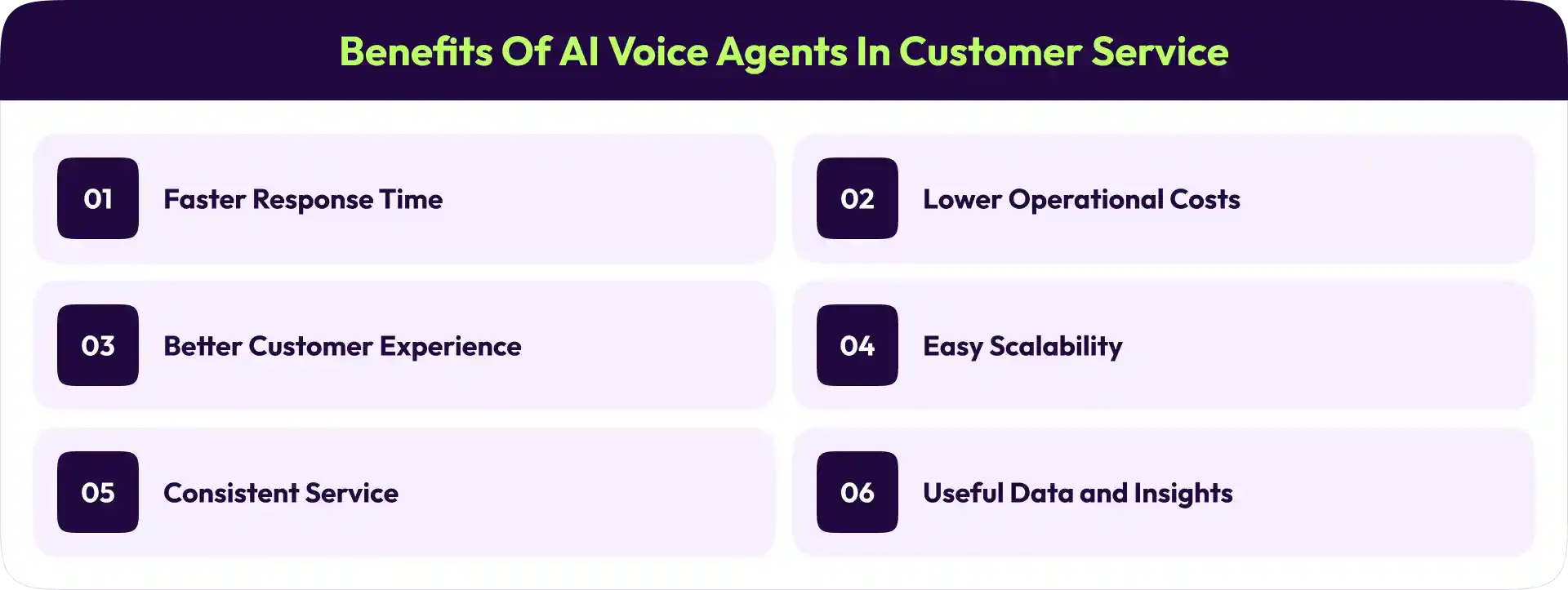
Key Benefits of AI Voice Agents in Customer Service
When implemented properly, AI voice agents offer several clear advantages.
Faster Response Time
Calls are answered immediately, reducing waiting time and frustration.
Lower Operational Costs
Businesses spend less on hiring, training, and infrastructure.
Better Customer Experience
Customers receive clear answers without repeated transfers.
Easy Scalability
The system can handle thousands of calls without adding staff.
Consistent Service
Every customer receives the same level of support.
Useful Data and Insights
Call records help identify common issues and improvement areas. Together, these benefits improve both customer satisfaction and internal efficiency.
Must-Have Features in a Voice AI Agent
Not all AI voice platforms perform well in real-world conditions. Before choosing an AI voice solution, check for these essential features. A reliable AI voice agent should offer:
Accurate speech recognition
Natural, human-like voice output
Integration with CRM systems
Real-time call analytics
Multi-language support
Strong security measures
Customizable workflows
Omnichannel capabilities
If a platform lacks several of these features, it may struggle at scale.
How to Choose the Right Voice AI Agent for Your Business
Selecting the right solution requires careful planning. A rushed decision often leads to poor results. Here is a simple framework to follow.
1. Understand Your Requirements: Start by analyzing:
Daily call volume
Common customer issues
Peak support hours
Language needs
2. Check Industry Compatibility: Some solutions work better for healthcare, finance, retail, or SaaS. Choose one with relevant experience.
3. Review Your Budget: Consider long-term return, not just upfront costs.
4. Evaluate Deployment Options: Cloud-based systems are usually easier to maintain.
5. Look at Customization: Avoid tools that force rigid workflows.
6. Assess Support Services: Strong onboarding and training are important.
7. Estimate ROI: Calculate how much time and money the system can save.
Why Alris Stands Out as the Best AI Voice Agent in 2026
While many platforms offer AI voice automation, Alris focuses on real usability and long-term reliability. Key strengths include:
Advanced natural language processing
High intent recognition accuracy
Custom model training
Enterprise-grade infrastructure
Global deployment capability
Smooth system integrations
Dedicated technical support
Instead of offering generic automation, Alris adapts to each business environment.
Alris vs Traditional Call Centers vs Other AI Tools
The table below shows how Alris compares with other approaches.
Feature
Traditional Support
Generic AI Tools
Alris
Cost
High
Medium
Low
Availability
Limited
24/7
24/7
Customization
Low
Medium
High
Accuracy
Medium
Medium
High
Scalability
Low
Medium
High
Customer Experience
Variable
Average
Good
Alris balances automation efficiency with conversation quality.
Real-World Use Cases Across Industries
AI voice agents are not limited to one type of business. They are useful wherever customers need fast, reliable answers. As more companies adopt voice automation, real-world applications continue to grow across industries. Below are some of the most common and practical use cases.
Healthcare
In healthcare, communication needs to be fast, clear, and accurate. Missed calls or long waiting times can affect patient satisfaction and, in some cases, outcomes. It help by handling:
Appointment scheduling and rescheduling
Reminder calls for checkups and tests
Basic medical inquiries
Clinic timings and availability
Insurance and billing questions
By automating these tasks, hospitals and clinics allow staff to focus more on patient care.
Banking and Finance
Banks receive thousands of routine calls every day. Most of them involve simple questions that do not require human intervention. AI voice agents are commonly used for:
Account balance inquiries
Transaction status updates
Loan application tracking
Credit card support
Fraud alerts and verification
This reduces waiting times and improves customer trust.
Insurance
The insurance industry depends heavily on communication. Customers often call to understand policies, file claims, or check coverage. Conversational AI voice agent supports insurance companies by managing:
Policy inquiries and renewals
Premium payment reminders
Claim registration
Claim status updates
Document submission guidance
Coverage explanations
For customers, this means faster responses. For insurers, it means fewer delays and lower operational costs.
E-commerce and Retail
Online shoppers expect quick answers, especially after placing an order. Delays often lead to frustration and negative reviews.
Order tracking
Return and refund requests
Delivery updates
Product availability questions
Store policies
This helps brands maintain a smooth post-purchase experience.
SaaS and Technology Companies
Software companies receive high volumes of support requests, especially during onboarding and upgrades. It assist with:
Account setup guidance
Password recovery
Subscription management
Basic troubleshooting
Feature explanations
This reduces ticket backlogs and improves onboarding.
Real Estate
Real estate agencies rely on quick lead response. Missed calls often mean lost deals. AI voice agents support:
Property inquiries
Visit scheduling
Lead qualification
Price and location information
Broker connections
This ensures no potential customer is ignored.
Logistics and Transportation
In logistics, timing and updates are critical. Customers frequently call to track shipments. Voice AI manages:
Delivery status
Route updates
Delay notifications
Pickup scheduling
Issue reporting
This improves transparency and reduces call center pressure. Across all these industries, one pattern is clear: AI voice agents work best when they handle repetitive tasks, allowing human teams to focus on complex problems.
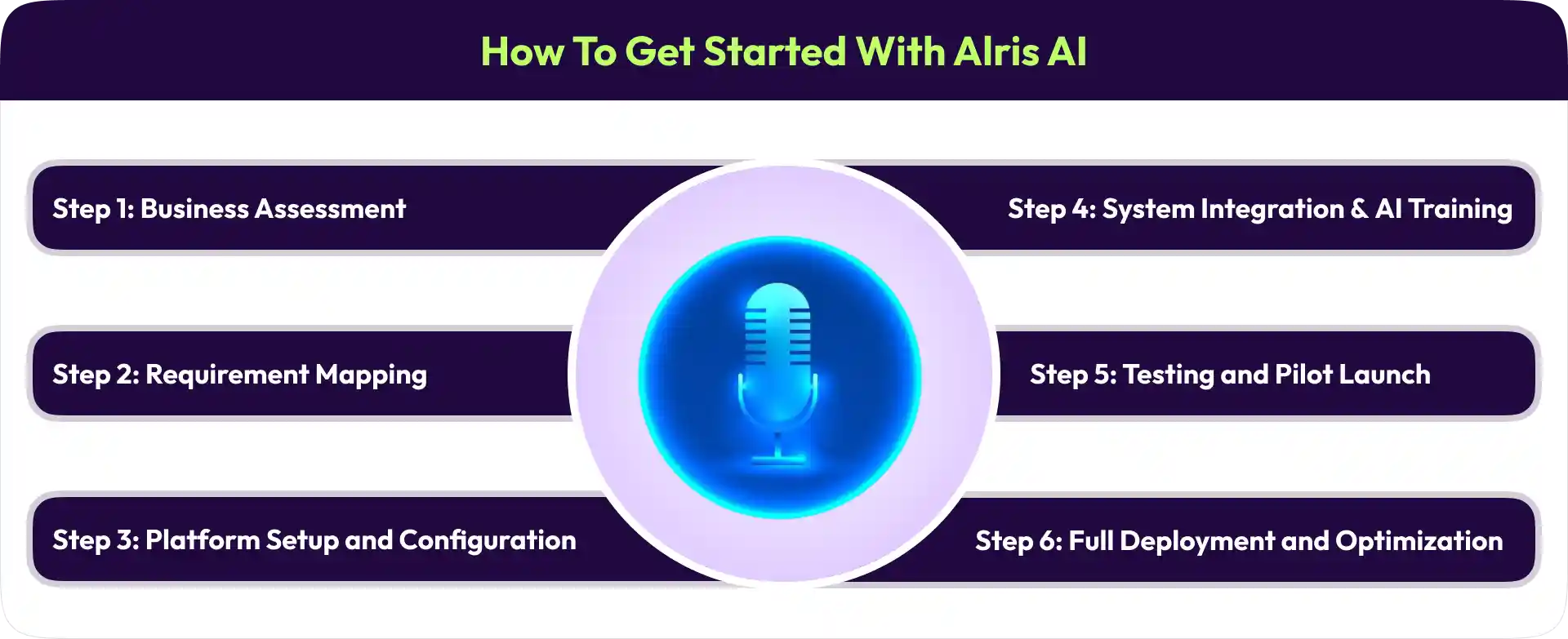
How to Get Started with Alris AI
Getting started with Alris AI is designed to be simple and structured. Most businesses can move from planning to live operations without major technical changes. The process focuses on clarity, testing, and gradual adoption to ensure smooth results.
Step 1: Business Assessment
The first step is to review how your current support system works. Call volumes, peak hours, common issues, and existing tools are analyzed. This helps identify where automation will be most effective and where human support is still needed.
Step 2: Requirement Mapping
In this stage, your business requirements are defined. Conversation flows, escalation rules, compliance needs, and language preferences are mapped out. This ensures the AI voice agent fits your operations and customer expectations.
Step 3: Platform Setup and Configuration
Once requirements are clear, the platform is configured to match your workflows. Voice responses, routing rules, and system settings are customized to reflect your brand tone and service standards.
Step 4: System Integration
Alris is then connected with your CRM, ticketing tools, and internal systems. This allows the AI to access real-time customer information and provide accurate, consistent responses.
Step 5: AI Training and Testing
Before launch, the system is trained using real call data and support documents. Test calls are conducted to check accuracy, tone, and flow. Any issues are corrected at this stage.
Step 6: Pilot Launch
A limited rollout is usually conducted first. During this phase, only part of the call volume is handled by AI while performance is monitored. Feedback is collected, and adjustments are made.
Step 7: Full Deployment and Optimization
After successful testing, the system is deployed fully. Performance is reviewed regularly, and workflows are updated based on real usage. This ensures continuous improvement over time.
Common Challenges and How Alris Solves Them
Every AI system faces challenges. Alris addresses common issues in the following ways.
Accent and Language Differences: Models are trained on diverse speech patterns.
Training Time: Pre-built templates reduce setup time.
Customer Trust: Natural voice tone improves acceptance.
Data Security: Encryption and compliance frameworks protect information.
Integration Complexity: Standard APIs simplify connections.
Internal Resistance: The system supports agents instead of replacing them.
Final Thought
Customer service today is about speed, clarity, and respect for people’s time. Customers want quick answers and simple conversations. They don’t want to wait, repeat themselves, or struggle with complex systems. AI voice agents help businesses meet these expectations when they are implemented properly. But technology alone is not enough. Real value comes from choosing the right platform, setting it up carefully, and improving it over time.
Alris AI offers a practical approach to voice automation. It focuses on reliability, ease of use, and real business needs. For companies that want to improve support quality while controlling costs, Alris provides a strong and sustainable solution.
Frequently Asked Questions (FAQs)
1. Will an AI voice agent reduce my support costs?
Yes. AI voice agents reduce the need for large support teams and lower training and infrastructure costs. Alris helps businesses handle more calls with fewer resources, improving efficiency and long-term savings.
2. Which industries benefit most from voice AI?
Voice AI works well in healthcare, banking, insurance, e-commerce, SaaS, logistics, and real estate. Alris supports industry-specific workflows, while Alris helps customize solutions for each sector.
3. How quickly can we go live with Alris?
Most businesses can launch a pilot within a few weeks. After testing and optimization, full deployment follows. Alris AI supports planning, setup, and onboarding to speed up implementation.
4. Will the AI understand different accents and languages?
Yes. Alris is trained on diverse speech patterns and supports multiple languages. It improves accuracy over time using real call data and continuous learning.
5. How does Alris integrate with our CRM and ticketing systems?
Alris connects with CRM and support tools through secure APIs. It can fetch customer data, create tickets, and update records automatically. Alris manages integration and testing.
6. Is customer data safe with AI voice agents?
Yes. Alris uses encryption, access controls, and compliance standards to protect data. We also help businesses align the system with privacy and security regulations.
About the author
Shravan Rajpurohit
Shravan Rajpurohit is the Co-Founder & CEO of The Intellify, a leading Custom Software Development company that empowers startups, product development teams, and Fortune 500 companies. With over 10 years of experience in marketing, sales, and customer success, Shravan has been driving digital innovation since 2018, leading a team of 50+ creative professionals. His mission is to bridge the gap between business ideas and reality through advanced tech solutions, aiming to make The Intellify a global leader. He focuses on delivering excellence, solving real-world problems, and pushing the limits of digital transformation.